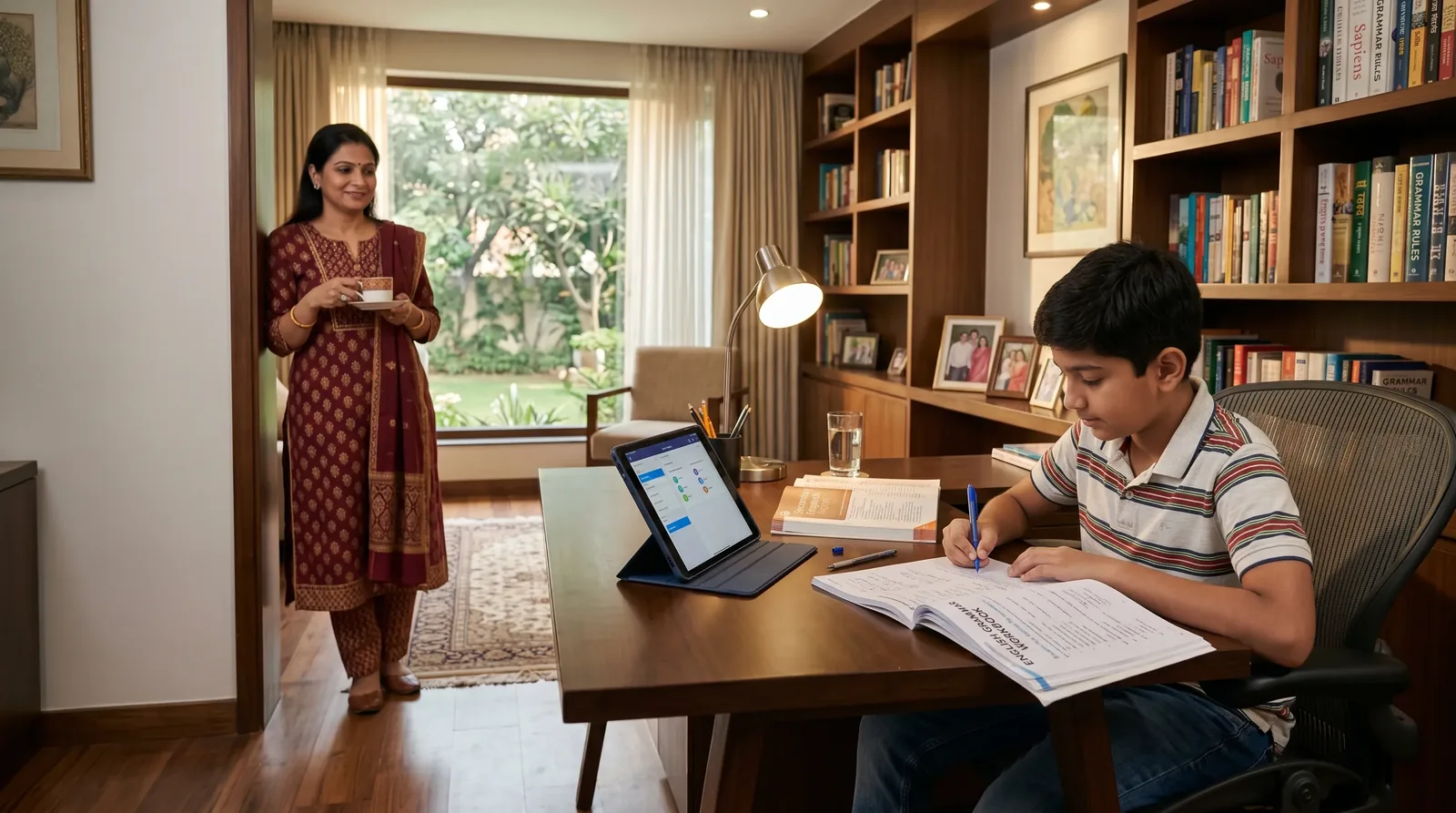
Parent teaching child grammar through real writing
✏️ Recommended ages 9–16 · Class 4 to Class 10

The Grammar Course

Parent teaching child grammar through writing

Fill in the blank. Underline the noun. Circle the verb.

Thousands done. Writing still hasn't improved. We teach grammar through writing — six interactive tools, real sentences your child actually writes.

Get Grammar Course →

Two tiers · Lifetime access · Instant delivery

📖 45 Modules ✏️ 6 Interactive Tools 🖨 220+ Worksheets 📊 Foundation + Advanced
🔒 Razorpay secured ✓ 7-day refund ⚡ Instant access 🏫 CBSE / ICSE / IB
✏️ Course Preview

See exactly what your child is going to learn

The six error families they're slipping on. The interactive tools that fix them. Preview every piece here — no signup required.

01 · The Six Families

The patterns Indian middle-schoolers slip on — backed by research

Kalapala & Kalapala (2020) studied written English in Indian schools and found 60% of errors fall into six families. Every one is covered. Swipe to see them.

Family A · Sentence Boundary
Two complete thoughts need real punctuation — not nothing.
My sister loves animals she has three cats and a rabbit.
My sister loves animals — she has three cats and a rabbit.
Run-ons & comma splices M18
Family B · Agreement
The verb has to match the real subject — not the nearest noun.
The list of winners were posted on the noticeboard.
The list of winners was posted on the noticeboard.
Subject-verb agreement M8, M34
Family C · Tense
Two past actions? The earlier one takes "had".
By the time we reached the station, the train already left.
By the time we reached the station, the train had already left.
Past perfect M6, M30
Family D · Articles
Hindi drops "a / an / the". English doesn't.
Mumbai is one of busiest cities in India.
Mumbai is one of the busiest cities in India.
A / An / The M10, M11
Family E · Pronouns & Prepositions
After a preposition, it's "me" — not "I".
Between you and I, the new teacher is strict.
Between you and me, the new teacher is strict.
Pronoun case M9, M13–M15
Family F · Punctuation
Extra info inside a sentence? Wrap it in commas.
My cousin who lives in Delhi is visiting next week.
My cousin, who lives in Delhi, is visiting next week.
Non-defining clauses M19, M26, M28
ABCDEF
Six families. Sixty specific patterns.
  • Tag questions ("isn't it?")
  • Reported speech tense shifts
  • Conditional sentences (if I had…)
  • Modal verbs (would / could / might)
  • Active ↔ passive transformation
  • Gerund vs infinitive
  • Sequence of tenses
  • Comparative vs superlative
  • 30 more patterns inside the course
See the two tiers →

Scroll for more families

02 · The Tools

Your child writes the grammar — doesn't memorise it

Tap any tool below — it works just like inside the course. The child fixes a real sentence, sees the change happen, and moves on. No worksheets in a binder. No watching videos.

Tool 01
Tap-to-fix
Tap each wrong word. The correct word takes its place.
Tap each highlighted word
"myMy brother who is older than me playplays cricket every sundaySunday."
Spot & correct M22 + many
Tool 02
Sentence Surgery
Four marks, four jobs. Tap each pink slot.
Tap each pink slot
Mom packed three items a tiffin a water bottle and a notebookexactly what I needed.
Colons · commas · em-dashes M18–M21
Tool 03
Lift-it-out
Test if a phrase is essential. Tap it out and see.
Tap the highlighted phrase
My brother, who lives in Mumbai, is a doctor.
✓ Still makes sense — the phrase wasn't essential. Non-defining clause, keep the commas.
Defining vs non-defining M19, M26, M28
Tool 04
Clause Builder
Pick the clause that completes the sentence.
Tap the matching clause
tap a tile… you will pass the exam.
If you study hard, Although you study, Because you study,
Compound & complex M12, M16, M34, M38
Tool 05
Error Detective
Spot the error in the sentence. Tap where you think it is.
Where's the error? Tap it.
"The shop was closed, we went home."
Comma splice. Two complete thoughts ("the shop was closed" + "we went home") joined by just a comma. Fix → "The shop was closed. We went home."
Diagnostic skill Used everywhere
✏️💬📝🔄🪄
Five demoed here. Plus five more tools inside the course.
  • Sentence Builder — drag clauses into the right order
  • Reported Speech Rewriter — direct ↔ indirect with tense shifts
  • Editing & Omissions — find missing or wrong words in CBSE-style paragraphs
  • Active ↔ Passive — board-style transformation drills
  • Transformer — watch sentences transform into correct grammar
  • All included · lifetime access
See the two tiers →

Scroll for more tools

03 · The Worksheets

Worksheets where your child actually writes — not just fills blanks

Every worksheet trains the writing reflex: a real scene with a situation prompt, a paragraph to edit, sentences to rewrite in full, original sentences to compose, simple sentences to combine. Tap any sheet to zoom in.

+ Many more inside
Every module ships with 5 worksheets + an answer key.
225
worksheets
2,400+
items
  • Graded difficulty within each sheet
  • Indian context — tiffin, cricket, festivals
  • Exact CBSE/ICSE board patterns
  • Answer keys explain the why
See the two tiers →
📄 5 worksheets per module · 225 across the course · all printable PDFs · answer keys included

Scroll for more worksheets · tap to zoom

Does Your Child Write Sentences Like These?

Check the ones that look familiar. Most parents recognise at least 4 out of 6.

Yesterday I go to the park and I am eating ice cream. Tense Mixing
She go to school every day. Subject-Verb Agreement
I bought book from shop. Missing Articles
He is good in cricket. Wrong Preposition
My mother told to me that I should study. Hindi Sentence Pattern
We went to park and we played and then we came home and then we ate dinner. Run-on / No Variety

These aren't random mistakes. They're the 6 error patterns that appear in study after study of Indian children's English writing — caused by Hindi grammar interference and how grammar is taught in schools. This course fixes all six.

Why Generic Grammar Exercises Don't Work

This isn't an opinion. It's what 50 years of research says.

📊 Landmark Study · Carnegie Corporation of New York
Graham & Perin (2007) analyzed 123 studies across Grades 4–12. They tested 11 methods of improving writing. Generic grammar exercises were the only method with a negative effect — an effect size of -0.32.
Graham, S., & Perin, D. (2007). Writing Next: Effective strategies to improve writing of adolescents. Journal of Educational Psychology, 99(3), 445-476.

Effect on writing quality (11 methods tested)

Strategy instruction
+0.82
Peer assistance
+0.75
Sentence combining
+0.50
Process writing
+0.32
Generic grammar exercises
-0.32
🇮🇳 Indian Study · IOSR Journal of Research & Method in Education
Kalapala & Kalapala (2020) analyzed 300 writing samples from Indian high school students and found: Subject-verb agreement errors in 70.66%, article errors in 64.33%, and tense errors in 61% of students.
Kalapala, K.R. & Kalapala, K. (2020). An Analysis of Grammatical Errors in Written English by High School Students. IOSR-JRME, 10(6), 22-24.

This course uses the methods that scored positive in the research — sentence combining, writing strategies, and error-pattern coaching — not generic grammar exercises.

What's Inside The English Grammar Course

11 units · 45 modules · Foundation + Advanced · Grammar through writing, not generic exercises

🧱
Unit 1

The Foundation

3 modules

Why generic grammar exercises don't transfer to writing — and what does. How English sentences work, why Hindi word order causes confusion, and the 6 error families this course fixes.

Why Generic Exercises Don't Work How English Sentences Work The 6 Error Families
Unit 2

Tense & Time

5 modules

The #1 error family — tense mixing. Why Hindi speakers overuse the continuous tense, how past tense works, when to use "will" vs "going to", and the critical skill of keeping tenses consistent across a paragraph.

Simple vs. Continuous Past Tense Future Tense Tense Consistency Perfect Tenses
🔗
Unit 3

Agreement & Structure

5 modules

Subject-verb agreement (the #1 error in the Indian study), pronouns, articles (Hindi has none — that's why your child drops them), and building compound and complex sentences.

Subject-Verb Agreement Pronoun Problems Articles: The Basics Articles: Hard Cases Sentence Structure
🧩
Unit 4

The Small Words That Matter

5 modules

Prepositions (in/on/at and the Indian-English errors your child makes daily), conjunctions beyond "and" and "then", and how to start sentences in different ways so writing doesn't sound flat.

Prepositions of Time Prepositions of Place Tricky Prepositions Conjunctions Sentence Variety
✏️
Unit 5

Punctuation & Mechanics

4 modules

Full stops (no more run-on sentences), commas that actually follow rules, apostrophes, and direct speech — all heavily tested in CBSE and ICSE exams.

Sentence Boundaries Commas Apostrophes Direct Speech
🏁
Unit 6

Bringing It All Together

2 modules · Foundation

The Grammar Detective framework — teaching your child to self-edit their own writing. Plus a capstone module that ties every rule together into a system your child can use independently.

The Grammar Detective The Complete System
Advanced Tier · M24–M44
🔗
Unit 7

Complex Clauses

5 modules · Advanced

The clause-level patterns that show up in Class 9–10 writing: conditionals, reported speech, participial phrases, and noun & relative clauses. Built on the clause-builder tool from M12/M16.

Conditionals: If–Then Advanced Reported Speech Participial Phrases & Dangling Modifiers Noun Clauses Relative Clauses: Deep Dive
🎙️
Unit 8

Style & Voice

5 modules · Advanced

The upgrades that turn a correct sentence into a strong sentence — the difference between a 6/10 and an 8/10 in essay scoring. Active vs passive voice, strong verbs, wordiness, parallel structure, and how a paragraph flows.

Active vs Passive Strong Verbs Eliminating Wordiness Parallel Structure Cohesion & Transitions
🔄
Unit 9

Advanced Agreement & Transformations

3 modules · Advanced

The tricky agreement cases (collective nouns, indefinite pronouns, neither/nor) and the foundation for sentence-type transformations the boards test repeatedly.

Advanced Subject-Verb Agreement Simple, Compound, Complex Transformations Degrees of Comparison
🎯
Unit 10

CBSE/ICSE Transformations

4 modules · Advanced

The exact transformation drills CBSE and ICSE board papers ask — affirmative ↔ negative, sentence types, synthesis, and sentence-variety for higher-order writing marks.

Affirmative ↔ Negative Interrogative · Exclamatory · Assertive Synthesis of Sentences Sentence Variety for Writing
📝
Unit 11

Board-Prep Writing

4 modules · Advanced

The four writing formats every Class 9–10 student is tested on, plus the editing & omissions paper that catches out the highest scorers. Practical, scoring-checklist driven.

Letter Writing Notice Writing Report & Article Writing Editing & Omissions
Get Grammar Course →

Learn at your own pace · Works on any device

Why Generic Grammar Exercises Don't Transfer to Writing

The research is clear — and here's what's happening in your child's school.

📝

Fill in the blank ≠ write a sentence

Your child can circle "goes" instead of "go" in a fill-in-the-blank exercise — but still writes "She go to school" in their essay. That's because generic grammar exercises test recognition. Writing requires production. They're completely different skills. Research calls this the "transfer problem."

📱

Grammar apps teach rules in isolation

Completing 50 tense exercises doesn't help when your child is writing a paragraph and juggling tense, articles, prepositions and sentence structure all at once. The brain can't apply isolated rules under real writing conditions — which is why composition marks stay low even when grammar test scores are high.

Correcting without explaining the pattern

"That's wrong, it should be 'goes' not 'go'" teaches nothing. When you can say "remember — when the subject is she/he/it, the verb gets an -s in present tense," your child has a rule they can apply to every sentence they'll ever write.

What Changes After You Take This Course

Grammar that shows up in your child's actual writing — not just on tests.

🔍

Your child writes a wrong sentence — and you know exactly which error pattern it is

Instead of "that's wrong," you'll say "check the subject — is it one person or many? What does the verb need?" and your child will fix it themselves.

✍️

Composition marks go up — not just grammar MCQ scores

Because every rule in this course is practised through real writing, your child's essays, stories and exam compositions improve — not just their ability to circle correct answers.

🇮🇳

Hindi-English interference stops

"I am knowing," "She told to me," "I bought book" — these errors come from Hindi grammar patterns. Once you understand WHY your child makes them, you can fix them at the root — not one sentence at a time.

📖

Homework time becomes productive, not painful

You'll know the 6 error patterns, the fix for each one, and exactly what to say when you see it. No more Googling grammar rules while your child waits.

🏆

Your child starts catching their own mistakes

The Grammar Detective framework in Module 22 teaches your child to self-edit. The end goal isn't a parent who corrects — it's a child who writes correctly the first time.

⏱ Why start now?

The earlier the eye is trained, the faster fluency builds.

The course is built for Class 4 through Class 10 — but every year you wait costs more than the previous one. Here's why.

1
The same six families show up at every age.
A Class 4 student writing "I am knowing" and a Class 9 student writing the same thing are slipping on the same pattern. The rule doesn't get harder — only the cost of leaving it broken does.
2
Correction reps compound.
A child who starts in Class 5 hits 4,000+ correction reps by Class 9 — muscle memory by middle school. A Class 9 starter has to do the same reps under board exam pressure. Same work, worse timing.
3
Built right through board prep.
The Advanced tier (M24–M44) maps directly onto the CBSE/ICSE Class 9–10 syllabus: conditionals, reported speech, synthesis, transformations. Same content the boards test — taught interactively, with the tap-to-fix and sentence-surgery tools doing the heavy lifting.
Best window: Class 4–7 for Foundation, Class 8–10 for Advanced. If your child can read a paragraph on their own, they're ready.

Pick your tier

Foundation covers Class 4–7 core grammar. Advanced adds CBSE/ICSE-style transformations for Class 8–10 board prep. Both lifetime access.

Foundation
The core grammar your child loses marks on. M0–M23.
₹999 + GST
  • 24 foundational modules (M0–M23)
  • All 6 error families taught from scratch
  • Every interactive tool unlocked
  • Tenses, agreement, articles, prepositions
  • Sentence boundaries, commas, apostrophes, direct speech
  • The Grammar Detective + Complete System capstones
  • 120 grammar worksheets & answer keys
  • Lifetime access · 7-day money-back guarantee
Get Foundation →

Not sure? Start with Foundation — you can upgrade to Advanced anytime by paying the difference.

What Parents Are Saying

From our ReadingCraft parent community

Ankit Sakhuja

Ankit Sakhuja · Founder, ReadingCraft

IIFT · CAT 99.9%ile (Verbal) · Orton-Gillingham Specialist · Author of 50+ decodable books.

Get The English Grammar Course

Pick your tier · Instant access · Lifetime · 7-day money-back

💡 Add board prep for ₹500 more
Advanced unlocks M24–M44 — conditionals, reported speech, CBSE/ICSE transformations, letter/notice/report writing, and editing & omissions. Class 8+ students get the most out of it.
✓ Complete tier picked — Foundation + 21 advanced board-prep modules.
📖 24 Modules 🎮 Grammar Games ✍️ Grammar Worksheets 📊 Progress
Foundation · Total payable ₹1179 (₹999 + 18% GST)
Lifetime access One payment
7-day refund No questions
Instant access After payment
Razorpay secured UPI · cards · netbanking
Common questions

Questions parents ask before buying

My child is in Class 6 — should I pick Foundation or Advanced?

Foundation. Class 4–7 students should start with Foundation — it covers the six error families and the grammar you're tested on at school. Advanced (M24–M44) is built specifically for CBSE/ICSE Class 8–10 board prep (conditionals, reported speech, transformations, editing & omissions, letter/notice/report writing).

You can always upgrade later by paying just the difference (₹500).

How long does my child have access?

Lifetime — one payment, no renewals. Your child can come back and revise any module, any worksheet, any tool, whenever they need to. Before a unit test. The night before pre-boards. During Class 10 revision. The summer between school years. Grammar is not a "finish it once" subject — having it available to revisit is the whole point.

Every future update is included too, no extra cost.

What if my child doesn't like it? Is there a refund?

Yes — 7-day money-back guarantee, no questions asked. Try the course for a full week. If your child doesn't engage with it, reply to your purchase email and we'll refund 100% to the original payment method.

Does the course follow CBSE / ICSE syllabus?

The Advanced tier (M24–M44) maps directly onto the CBSE and ICSE Class 9–10 grammar syllabus — transformation of sentences (active/passive, reported speech, simple/complex/compound, affirmative/negative), modals, conditionals, editing & omissions, and the formal writing types (letter, notice, report).

Foundation (M0–M23) is the prerequisite — the core grammar both boards assume your child already has by Class 8.

Can two of my children share one account?

Second child gets 50% off the same tier. One account per student keeps progress tracking meaningful. After your first purchase, reply to your purchase email with the second child's name — we'll set up their account at half price (Foundation ₹500, Advanced ₹750).

Will I get WhatsApp updates and reminders?

Only if you opt in (the checkbox on the registration card). We send: a weekly progress nudge for your child, alerts when new modules ship, and one or two parent tips per month. No spam. Reply STOP to leave the list anytime.

Two tiers · lifetime access

From ₹999 + GST